Tuesday, June 20, 2017

World Refugee Day

Today, June the 20th is the World Refugee Day. As UN Secretary-General, António Guterres  says: "I’ve met so many who have lost so much. But they never lose their dreams for their children or their desire to better our world. They ask for little in return – only our support in their time of greatest need"  If you are in Geneva, join the  Refugee Cultural Festival- still some days to go and great experiences to be part in. 
Anila Hussain ran Bollywood dance workshop which was part of the Refugee Cultural Festival.
#photography #documentary #photojournalism #reportage #webster #nikonpro #iraq #keystone
#yazidi #refugee #sinjar #worldrefugeeday

Friday, June 16, 2017

Bhutan Archive with Keystone

I am happy to share that my pictures from Bhutan are now available through Keystone in Switzerland. An amazing place, hopefully a Workshop will be organised again in the not to distant future!
In Thimphu, Bhutan, Choki Traditional Art School educates young men and women on the traditional Buddhist arts. Everything from wood crafts to painting and embroidery is all taught here. The students will later work on preserving the history as well as the traditions of the art that evolvs around the monasteries as well as the different festivals that takes place in Bhutan. An example is the "Tigers Nest". A few years ago, it got severely damaged and the students from  Choki Traditional Art School is heavily involved in recreating the works of art at he monastery.
Traditional wood craft at a workshop near Paro, Bhutan.
Tango Monastery, Bhutan
Traditional wood craft is important in order to preserve the historic sites in Bhutan.
Tango Monastery, a Buddhist University, Bhutan.
A young Monk plays badminton at the Dechen Phodrang Monastery in Thimphu, Bhutan.
Young Monks at the Dechen Phodrang Monastery in Thimphu, Bhutan.
Young Monks at the Dechen Phodrang Monastery in Thimphu, Bhutan.
"Highway 1" is being worked on constantly. The distance between Paro and Thimphu is about 50km but can take more the 4 hours to drive.  It gets difficult when you meet larger vehicles on what is essentially a one lane dirt road. The road is better closer to the cities.
Children playing near the Chimi Lhakhang Monastery. The children are also revealing bad teeth.
In Bhutan, Archery is the national sport. One can see the sport being competed in a number of different venues. I will come back to that later, but Khuru is also popular! Khuru is a "dart like" sport where the guys competing tries to hit the target around 20 to 40 meters away. Their precision and courage is impressive. The "dart" is pretty big, the target pretty small and the guys standing near the target seems to be worryingly close while the competition is throwing the dart.
Men playing Khuru in Punakha, Bhutan. Khuru is a traditional Bhutanese sport. It involves throwing darts outdoors with a target approximately 20 metres.
Nuns are praying at the The Sangchhen Dorji Lhuendrup Nunnery in Punakha, Bhutan.
Spectators at the Changlimithang Archery Field in Thimphu, Bhutan. Archery is a national sport in Bhutan. 
Walking to The Tigers Nest Monastery (Paro Taktsang or Taktsang monastery) takes about 2-3 hours. Making the walk in the morning imporoves the chance to see the spectacular views. The monastery is located near Paro and is only accessible by foot. It hangs on a precipitous cliff at 3,120 metres (10,240 ft) above sea level and  about 900 metres (3,000 ft) above the Paro Valley. 
Walking to The Tigers Nest Monastery (Paro Taktsang or Taktsang monastery) takes about 2-3 hours. Making the walk in the morning imporoves the chance to see the spectacular views. The monastery is located near Paro and is only accessible by foot. It hangs on a precipitous cliff at 3,120 metres (10,240 ft) above sea level and  about 900 metres (3,000 ft) above the Paro Valley.
Paro Dzong, otherwise named Rinpung dzong. Monks talking together outside the Paro Dzong.
The Changangkha monastery is located in Thimphu, the capital of Bhutan. This is the temple where parents come to in order to name their children- they pick a name from the available names at the temple. It is thought that this process as well as the blessings from the local Llama is bringing good luck to the child. Apart from the Royal family, there are no family names given in Bhutan.
#reportage #photography #photojournalism #nikonpro #bhutan #workshop #travel #d810 #nikon #keystone #documentary #explore #happy #himalaya #monastery #tigersnest #photographyworkshop #switzerland #paro #keystonephoto

Thursday, May 18, 2017

Rwanda, Project: Bed for Janviere: Delivered!

I recently came back from Rwanda. The mission this time was a pleasant one, to deliver the hospital bed to Janviere that we had successfully fund-raised. The story of Janviere started about a year and a half ago. I was visiting Rwanda for the third time continuing my long term project on what life is like after having experienced Genocide. I was visiting with my friend Révérien who now lives in Switzerland. We went to the village where he grew up and where he witnessed the murder of his entire family, 43 people. He himself was badly injured. he was 15 years old. On the last day, he told me we were to visit his friend, Janviere. In 1994, during the genocide in Rwanda, Janviere was 11 years old. Her family was also killed and she had been thrown into a latrine. The result was that she broke her back and is now paralysed from neck and down. Since the genocide in 1994, Janviere has spent most of her time indoor. Her bed is not mobile. She cannot move at all, apart from her left hand. She can not sit in a wheel chair.  With Reverien, we decided that it must be possible to get her a bed or something that can help her get outside more. Upon my return to Switzerland, some of the work from Rwanda is available through Keystone photo agency. I did several exhibitions and presentations. While doing so, we started a fund raising campaign. I met with potential partners/ clients and the result was that we got a bed, a hospital Stryker bed, donated by MC Group in Holland (Hospital). The box made for the shipping was made for free by Noord nederlands klussenbedrijf, Nelipak donated towards the packaging, Rhenus Drachten gave us favourable fares for the freight. The people at Polyganics were all amazing and took care of the rest of the expenses in order top make his project a success- thank you Marcel, Paul, Romke, Rudy, Marietta and everybody else involved, including the family of Révérien!
The bed, packed and ready to leave from Holland (Polyganics office) and to be sent to Rwanda. 
I also have to mention everybody who donated towards this project. A crowd funding page was set up with 100 days. The goal was to raise CHF 5000 and buy a bed for Janviere. We made our target thanks to many (29) individual contributions! So, I am back from Rwanda, the bed was finally delivered after some initial problems with timing, visa etc... But, I can report back that Janviere is very grateful and extremely touched by the generosity by everybody involved!
Janviere stays most of the day in her regular bed. I brought her some photos from the previous trip with Reverien.
Janviere and Révérien first met when they were 11 and 15 years old. They where next to each other at the field hospital when they were found injured during the genocide in Rwanda.

John and Theodore and his family are helping preparing the bed which was delivered at their house last December (2016). 
Teta Aniella, Theodore's daughter is participating in the preparation of the bed. 
and so are his other two children, Ngango Alrick and Inez Paskella!
And, of course Theodore. 
The children taking advantage of the box used for transporting the bed- finally- it's empty!
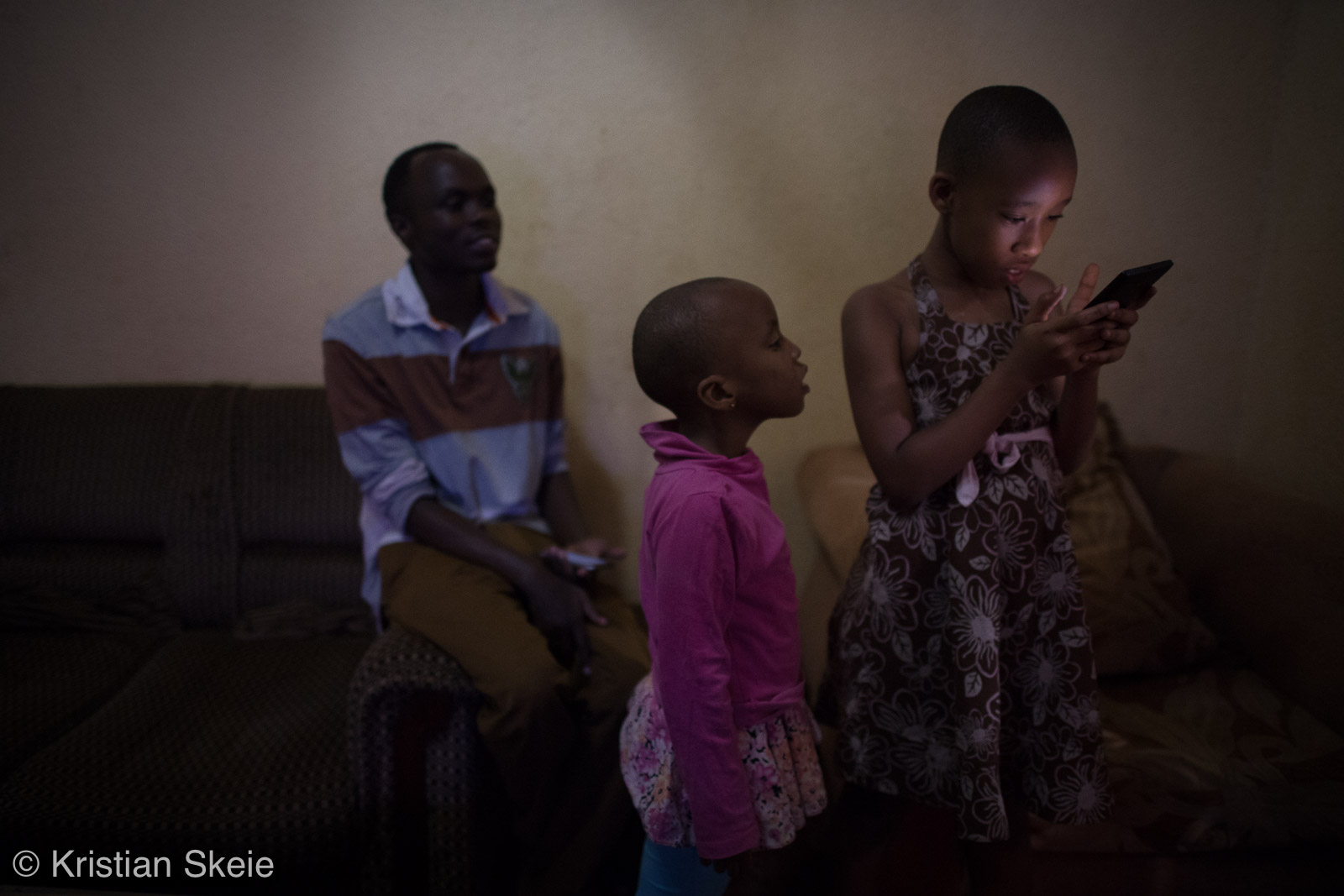
Teta Aniella playing a mobile game.
John lending his phone to the kids.
Ready to go! 
Inez Paskella at the door, the mattresses are stacked inside the day before delivering the bed.
It is rain season in Rwanda, muddy and grey outside.
A pick up truck is used to transport the bed.
The guys helping to load up properly.
It is about 3 hours to drive between Kigali and Kibungo, where Janviere lives.
The Stryker bed is pretty easy to handle and to clean. It does not require any electricity.
Mission accomplished!
Janviere was eager to try her new bed. 
Finally, outside. For the first time, Janviere could stay outside on her balcony. 
The only times she spent outside in the past, was when going to hospital.
Janviere expressed much gratitude towards everybody who have helped contributing to her new bed.
So, final note- Postcards and prints are currently being made and will soon be on its way to various contributors! 
#genocide #neveragain #photography#documentary #photojournalism #reportage #webster #nikonpro#keystonephoto #100days #ronorp #photobastai #switzerland #geneva#lausanne #zurich #wha

Wednesday, April 19, 2017

Earth Day, 22nd April 2017.

The Earth Day is this year on April 22nd. The purpose is to put focus on protecting the environment and to bring all 193 countries together. The image here is from Mali and is about protecting the animals in the Mali city zoo in the best possible way. It was photographed while on assignment for the Aga Khan foundation; I remember them telling me: "We agreed to be involved in this project as long as everybody agreed that the zoo was going to be the best zoo in Africa!"
The zoo keeper has a very close relationship with the animals at the Bamako city zoo.
The focus is on giving the best possible conditions for the animals that are already here.
#photojournalsim #storytelling #onassignment #earthday #zoo #bamako #mali #agakhan #animals #africa

Monday, April 10, 2017

23rd Commemoration of the 1994 Genocide against the Tutsi in Rwanda, organised by Ibuka Suisse.

On Saturday April the 8th, Ibuka Suisse commemorated the 1994 Genocide against the Tutsi, in Geneva. It was a nice ceremonial event where people came and spent time commemorating what happened in April- June 1994 in Rwanda. It was also a time to meet new people and to experience some Rwandan traditions.
Members of the Rwandan community in Geneva lighting candles
to honour the victims of the 1994 genocide. 
Everybody present lights a candle in an opening ceremonial houser to the 1 million
victims of the genocide in Rwanda. 
#genocide #neveragain #photography #documentary #photojournalism #reportage #webster #keystonephoto #nikonpro 

Wednesday, March 22, 2017

World Water Day 2017

March 22 marks the World Water Day. As I am currently preparing and researching my next project in Rwanda, I think of what access to water mean. In Rwanda, a country who is rapidly modernising and improving when it comes to economy, infrastructure and generally speaking quality of life, 3 million people does not have direct access to fresh water.
These kids are carrying water home at the end of the day, a necessity, as there are few houses in this region with direct access to water.
#genocide #neveragain #photography #storytelling #photojournalism #worldwaterday #keystonephoto #nikonpro #rwanda

Friday, February 24, 2017

FIFDH Humanitarian Film Festival and Forum- Geneva March 11th at 14:30- Maison des Arts du Grütli.

Yazidi refugees near Dohuk in the Kurdistan/ Iraq region near Sinjar. June 2016.
Come and join us at the FIFDH Humanitarian Film Festival and Forum- Geneva. I will, with Vicken Cheterian present some of the stories we worked on in Iraq last June. 

Images will be exhibited in the bar area downstairs throughout the Festival!


#photography #documentary #photojournalism #reportage #webster #iraq #keystone
#halabja #sinjar #refugee #chemical #genocide #fifdh2017 #grutli

Sunday, February 05, 2017

Rwanda- soon back again.

A souvenir- research in progress.
The people living up on the hills in Bisesero, Rwanda, are preparing for the evening part of the commemoratin taking place on April 7th. 2014- 20 years after the Genocide against the Tutsi.
#genocide #neveragain #photography #documentary #photojournalism #reportage #webster #nikonpro  #keystone #reverienrurangwa #rwanda

Thursday, January 19, 2017

Yazda reopened.

Good news, Yazda, the NGO located in Dohuk, supporting the Yazidi people in the Sinjar region has reopened after a series of positive meetings with the Kurdistan Regional Government “KRG”. It means they can restart the projects in the region.
Jamil Shawmar talking to Vicken Cheterian at the Yazda Head office in Dohuk, Iraq

#photography #documentary #photojournalism #reportage #webster #nikonpro #iraq #keystone #yazidi #refugee #sinjar #peshmerga #yazda

Tuesday, January 17, 2017

Halabja, Kurdistan Iraq- 28 years after the Genocide.

Dana Omar Ali was only 6 years old  (Born 1982) in 1988. He lived in Halabja, a city in Iraq, close to the boarder of Iran. Saddam Hussein was the totalitarian Dictator who ruled the country. In 1988, he ordered a chemical attack on Halabja. Dana Omar Ali survived. He became  a university educated teacher. Since the attack, he had developed a small 'cough' but did not think it was anything serious. 4 years ago (as of June 2016), his lung capacity collapsed and he is now destined to stay in bed and needs a breathing machine to survive. UPDATE: Dana Omar died on May 1st. 2017.
Dana Omar Ali at his home in Halabja (June 2016)
This is a fairly common story in the city where over 5000 people were killed and over 7000 people injured. Many of the survivors today have developed problems, like Dana Omar Ali, after the attack.

Kamel Abdel Kader was born 1973 and was 15 years old during the  chemical attack. He survived continued to live relatively normally. He got ill 8 years ago and is now, just like Dana Omar Ali, living with a breathing machine.
Kamel Abdel Kaderat his home in Halabja (June 2016) 
Friends, including the Mayor of Halabja, Khder Kareem, (second from the left) are visiting Kamel Abdel Kader.
Today, Halabja is a small city of about 117000 mostly Kurdish people. ‘The chemical attack happened towards the end of the Iran Iraq war- the Kurds in the Halabja region was supported by Iran. On March 16th 1988, after two days of ordinary artillery attacks, Iraqi planes dropped gas canisters on the town. The town and surrounding district were attacked with bombs, artillery fire, and chemical weapons, the last of which proved most devastating. At least 5,000 people died as an immediate result of the chemical attack and it is estimated that a further 7,000 people were injured or suffered long term illness. Most of the victims of the attack on the town of Halabja were Kurdish civilians’. (Wikipedia). 
Girl on bike in the Jewish quarter in the city of Halabja, Iraq in June 2016.
Two women walking in the Jewish quarter in the city of Halabja, Iraq in June 2016 
Street Marked in Halabja, June 2016.

No one knows exactly what was used, but it is believed that nerve agents Tabun, Sarin, VX as well as Mustard gas was used. Some argues that cyanid also was used.
The memorial cemetery in Halabja where victims of Saddam Husseins chemical attack of 1988 are buried. Baath's party members are not allowed to enter.
The memorial cemetary in Habaja is located in the outskirts of the town.
The memorial cemetery in Halbja, Iraq, a sculpture symbolises the victims of the attack in 1988. Some young people use the place to relax.
I visited Halabja in June 2016 with journalist Vicken Cheterian. 

#photography #documentary #photojournalism #reportage #webster #nikonpro #iraq #keystone #halabja #refugee #chemical #genocide